
It’s often a matter of propriety to shower praise on the dead. The more so when the deceased is human. But even that is apart from some rare occasions. Like when Nigeria’s then conscience, the Late Gani Fawehimi, upon the death of our erstwhile maximum ruler Sanni Abacha, wished he’d burn ‘in the hottest part of hell’.
However, when the demise is of an inanimate being, one is left more at ease to say the truth. Like the sign outside a church somewhere in the Western Hemisphere urging its congregation to strive to lead better lives. But, unbeknownst to all, this was not just to see them make heaven. More important was the earthly need to save the clergymen from having to tell blatant lies at their funerals.
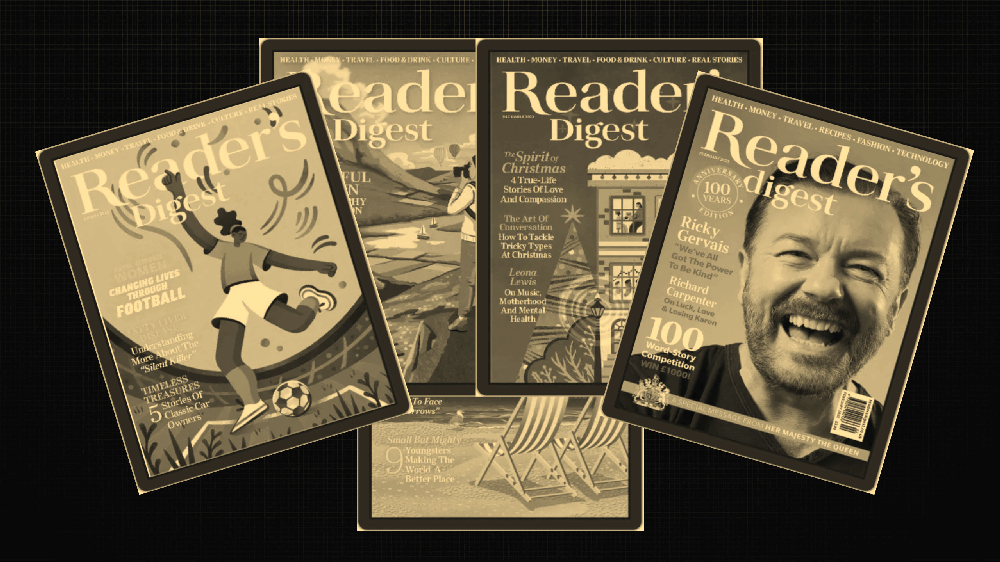
So this morning, urged forth by Keats’ to a nightingale, I finally downed enough glasses of liquids with ‘beaded bubbles’ at their brims to attempt one to the good, old British Edition of the 1922-founded American general-interest family magazine Reader’s Digest. O yes, it’s no longer news that the up-to-then ageless publication got rested last month after a whooping 86 years.
This unforced tear(s) from my reddened eyes should have sufficed. But not without the ensuing eulogy. Not when a guy can hardly recall the first time one set his inchoate eyes on the gem. Of course, born to teacher parents like I was, there was always readable stuff around the house. Though as meagre as their modest salaries, they were always to kept their children busy enough to dream.
Like a dog-eared copy of Pears Encyclopedia, the occasional Reader’s Digest and sundry daily readers that each gets to see upon growing up. Expectedly, we honed our reading and comprehension abilities on them. Much before either of our short hands could boast that envious roundtrip to the alternate ear needed to make school. Inevitably that saw us gaining a mastery of the meaning and usage of words ahead of our peers.
Of course, we waxed strong in the precocious attainment it showered on us for long. Until we chanced upon a picture in one of them. In it, a boy was spying upon a congress of baboons from a covering in a wood. It had him musing thusly: I saw standing before me… Who could have thunk it! To imagine someone seeing something afore of himself. If nothing else, it had us – my elder brother -and I – declaring the volume an anathema.
The truth be told, that misunderstood faux pas remains part of the reason, it was the infrequent back files of the British Edition of Reader’s Digest that ultimately got me. What with its table of contents appearing on its cover. The many articles apart, there were the regular features like Laughter Is The Best Medicine, It Pays To Increase Your Word Power, Humour In Uniform, Book of the Month, Quotable Quotes, Points To Ponder and their like.
And so it turns out that upon the breaking of the news of the magazine’s ‘death’, my mind had flashed to a copy I had recently acquired from a used-books stall I consult frequently. Dated July 1967, I could not but fish it out from its shelf space in my library. Published when I was a child soldier in Biafra, it served at waking up all the hibernating kicks on offer by the publication.
Like this brief exposè of the content of this edition will opine. Not unlike wine in a cask, it has all the attractions to still pack a punch. In fact , the passage of time appears to have added another feather to its cap of influence. Enough, indeed, to fill one with too much nostalgia for the decades that have been crossed ever since.
Most so, the lead article by James Stewart-Gordon on the achievements of one Colonel Eric Hefford who ‘presents new nations to the World with royal pomp and impeccably timed circumstance’. Titled Britain’s Impresario of Independence, it detailed how the retired British soldier masterminded the Independence celebrations of Nigeria on October 1, 1960; Sierra Leone, April 27 1961; Jamaica, August 6 1962; Tanzania, December 9 1961; Malta, September 21 1964; Guyana, May 26 1966 and Barbados, November 30 1966.
According to the story, he resumed the enviable occupation when, upon retirement in 1958, a friend he had met in Africa had asked him over to Nigeria to organise Nigeria’s independence celebrations. In Lagos, there was no hindrance to the sealing of the deal with the Prime Minister, the Late Abubakar Tafawa Balewa. Not even when it came to the cost:
Balewa: How much?
Hefford: Ghana spent over a million pounds…
Balewa: Fine. We want ours to be twice as good.
Hefford: That will cost two million.
Balewa: Go ahead.
Hefford: I’ll need a million to get started.
Balewa: You can pick it up on your way out.
Reportedly, that of Malta took just 130,000 Pounds.
News about Nigeria apart, the issue was laden with some time-honoured pieces. A stand out is The Man Who Tamed the Motorcycle on a Japanese millionaire who ‘has put his machines on every road in the world. His name? Soichiro Honda. Need I say more. Perhaps the likes of Chief Innocent Chukwuma of Innoson Vehicle Manufacturing Company (IVM) and other local innovators in our automotive startups can never walk alone.
Indeed, the articles in the magazine appear to have gained more prominence with age. Like yet another piece on the head of Jesus’ apostles titled Peter, the Sinner Turned Saint. Written by a certain Ernest Hauser it detailed how the ‘(O)ften blundering, often in doubt’ fisherman ‘conquered his many human failings to become… the Rock on which the Christian Church was founded.’
Perhaps, as though to further thicken the potpourri, the Book of the Month back then was Madame Sarah: The Story of Sarah Bernhardt, a condensation of the French actress’ life and times by Cornella Otis Skinner. It detailed the many achievements of the thespian who literally beat her irons unheated; bestriding the taut peripherals between stage and screen with uncanny calm.
Though the publication is still existent in its USA and other editions, I shall still occasionally shed tears for its British Edition. Not unlike I did – and still do – for other local and international periodicals.
Like the humour-packed Punch in London. That one to me was like the crucifixion of laughter.
Locally, I still mourn the closure of Crown Prince and Mister magazines of Lagos where I’d practised the trade.
